
Ceiling Repair
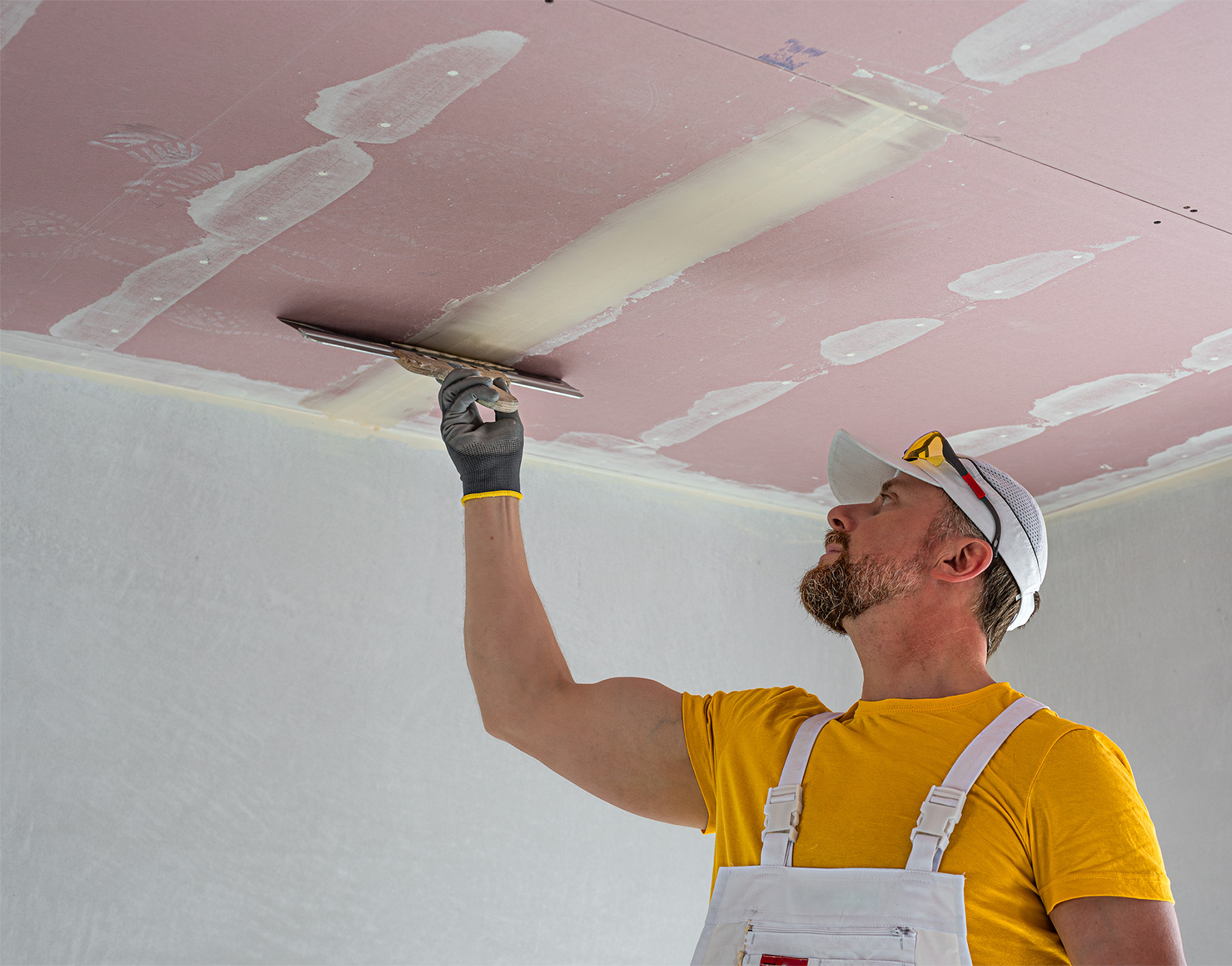
Ceiling Repair
Lets say that someone has stepped through your ceiling and damaged your Tulsa Drywall. The first thing you need to do is check and see how much damage there is and remove any loose pieces as they will not help you when making the repair on your Tulsa Drywall. Then you will need to cut to make sure that you can attach to the ceiling joists but don’t cut beyond halfway so the rest of your ceiling doesn’t fall as well.
Then you need to cut a piece of Tulsa Drywall to fit the newly cut hole and secure it with drywall screws.
Make sure you don’t drive the screws past the paper on the drywall. Then when starting your repair you will need drywall joint compound and a taping knife preferably a metal one so you can get the best result. Make sure when applying the joint compound to your Tulsa Drywall that you leave a thick layer before adding your tape so that it is properly coated. Then scrape down the tape to remove as much join compound from under the tape as possible so it will bond to the Tulsa Drywall. You will need to make multiple coats to get the proper amount of join compound before sanding it smooth. Once the patch is smooth and no tape is showing then you are ready to move on to the texture matching portion of repairing the ceiling of your project.You can repair the ceiling with out cutting to wood just by adding a few boards behind the hole and putting some screws on the old ceiling and in the new drywall. After you have the new piece of Tulsa Drywall installed you can now move on to the taping and mudding process. First make sure to remove and loose pieces of Tulsa Drywall as if you do not they will make repairing the ceiling impossible. You want to make sure that you are using the same thickness Tulsa Drywall as what is on your ceiling. After installing the patch of Tulsa Drywall make sure to cut away any hanging bits of paper and cut a small “v” groove around it to help the joint compound stay put.
After you have a layer of join compound preferably “fourty five minute” mud to give you some time to work with it you can then add your tape to the joint. After the joint compound has fully dried on your Tulsa Drywall you can then add a second layer to build up the thickness of the patch. When you have finished the second layer you can now begin the sanding process to get the area nice and smooth but dont sand too much as if you sand away the second layer and expose the drywall tape you must start again with another layer. Once you have finished with the sanding and got the patch smooth you can move to the texturing by using a spray can from a box store just make sure to test the spray of a piece of cardboard before using on the patch. You can just leave it smooth but just make sure to make the patch bigger than the damaged area to give you room to feather the patch so you can’t see it after it is painted. Once you have patched the damaged area make sure to use a drywall primer that your local paint store recommends before you try to put paint on the patch because it will show through the paint as drywall is like a sponge when you try to paint it without a primer to help close up the holes in the drywall. When repairing your Tulsa Drywall on the ceiling make sure that there are not any loose pieces hanging down or that the drywall is not loose because if it is moving around it will crack later. You can use different types of tape for the repair like fiberglass mesh or paper tape, the fiberglass mesh tape is useful because it has an adhesive on the back to help with it sticking to the drywall but is not as strong as the paper drywall tape. One way to repair smaller holes is to do what is called a “california patch” where you use the paper on the drywall as the tape but this really only works for small holes. You may find that you will need to add some wooden supports behind the patch to help secure the Tulsa Drywall and you can use things like a 1×4 piece of wood that you will need to cut down to size to fit, just make sure that you measure the opening and add some length to the 1×4 so it will overhang the hole. You can then use drywall screws to secure it to the old ceiling and now you have a place to put screws in the patch. You can also get some metal clips that work the same way but are easier for some people to use. After you tape and mud the patch you can then move to sanding but be sure that you do not sand too much as you will have to start over from the start if you sand away the mud from the tape. You will need a drywall primer before you can paint as the paint will soak into the drywall like a sponge and mess with the sheen of the paint. If you have any water stains or smoke stains you will need to get a stain blocking primer because it will show through the paints even with multiple coats. Hot mud is recommended because it will dry fast and will be stronger once dry. You will just have to be fast when applying it to the Tulsa Drywall. Multiple coats will be needed to insure the best end result and it will give you room for sanding to feather the edges of you patch on your Tulsa Drywall.
When matching texture on your Tulsa Drywall it is important to make sure that you make a few test spots to help dial in and practice to get as close a match as you can. No match is ever going to be perfect but you can get it very close as possible on your Tulsa Drywall. If you are using a pre-mixed spray can from a big box store, make sure to soak it in hot water first to loosen up the mixture inside the can to make it easier to spray. After you have soaked it, the next step is to shake it for a few minutes before spraying. When you have done that, find a piece of cardboard to test spray first before going to your Tulsa Drywall. Take that piece of cardboard and after you make a test spot and adjust the can to get the spray to as close as possible match, go to the wall and hold it up there to check and see how close the match is. Make sure the Tulsa Drywall is dry before you spray the texture on there as the water will mess up the texture. After you have sprayed the texture it is important to check and see before it fully dries to see how good the match it so you can wipe it away with a wet sponge if it doesn’t match and if that happens then you have to let the Tulsa Drywall dry before you can spray it again. Once you have the texture matched you can then move on to the painting process. There are a few different ways to match texture on your Tulsa Drywall one is with a spray can from a box store and the other is with a hopper gun. The hopper gun requires you to mix the mud and have access to an air compressor. The hopper gun will match your texture better but is more difficult to use as without proper preparation it can spray texture on things that you may not want texture on. Make sure that you use masking paper and tape to cover the things that you do not want to get texture on. When texturing your Tulsa Drywall make sure to stay back approximately three feet and to keep moving so you don’t make a thick spot in the texture on your Tulsa Drywall. The hopper gun has different nozzles for different wall textures; the smaller nozzle would be for what is called an orange peel texture and is one of the most common textures for the Tulsa Drywall. The Larger nozzle would be more useful for a knockdown texture. Depending on the style of your home you can have a variety of different textures on your Tulsa Drywall. A very popular texture is what we call an “orange peel” texture and depending on what year your home was built it could be what is called a “knockdown Texture”. Both textures are a very nice complement to a home and can add a very subtle or not so subtle look to your Tulsa Drywall. You can also do a smooth finish but it can be a very difficult finish because you have to make sure that your walls are properly repaired because a smooth wall will not help to hide any imperfections. The reason people like texture is because of how well it can help to hide imperfections on the walls. The orange peel texture gets its name because it looks like the peel of an orange. How creative is that, so the next time you are buying oranges from the supermarket you will now think about the walls of your home with Tulsa Drywall. There are different techniques that can be used to get different textures like a roller that looks kind of like a stucco or a hand texture using a trowel to get a unique looking hand texture on your Tulsa Drywall. A knockdown texture uses a gun with an air compressor attached to it to spray the joint compound on the wall, after you wait for 10-15 minutes you can then very lightly drag your drywall knife across the splatter from the hopper gun and create a knockdown texture. Make sure that you clean the walls from dust and check for any damage that you need to repair before texturing as it is easier to repair now before you texture but not impossible. Mix the joint compound until you reach a thin peanut butter consistency, you can now add it to your hopper gun. After you have sprayed and got the texture you want you must wait 24 hours for it to fully dry and then you can now prime it with a drywall primer, your local paint store can help you to get the right primer, after that you can now paint the wall after the primer has dried fully. Make sure to cover your floors with paper to keep the drywall joint compound off of it. A lot of people will put dish soap in the drywall joint compound and it does work but can cause problems with the paint not sticking fully and can peel off, so it is not highly recommended to do that. The pre-mixed spray can from box stores is a good alternative for most homeowners and small repairs even in a professional setting as they can match very well and are easy to use to match the texture on your Tulsa Drywall. You can also do a smooth finish as a form a “texture” for a more modern look in your home but is a more difficult finish as it takes a lot more prep work and sanding with multiple coats of drywall joint compound to get your Tulsa Drywall to look amazing. You will need different sizes of drywall knives like a 3 inch and even up to at 10 inch drywall taping knife depending on the size of the area you are working with.
When installing your Tulsa Drywall make sure you use the proper screws and don’t run the screw past the paper on the Tulsa Drywall. Make sure you install it with the white colored paper facing out and the brown colored paper facing to the inside of the framed wall. The sheets of Tulsa Drywall should be installed horizontally in most cases to use as much of the sheet as possible. Check and make sure that before you install your Tulsa Drywall that there is nobody leaning or sleeping in the wall as to not cover them up, because that will make the finish work more difficult. After you have checked to see that there is no one in the wall and nothing in the way you may proceed with installing your Tulsa Drywall. You need to have five screws starting from the bottom and going up on each stud, they should be on sixteen inch centers on a standard framed home. Proper installation of your Tulsa Drywall is important for the integrity and insulation value of your home. We have all seen what bad Tulsa Drywall looks like and it is one of the main things the people will see in your home so make sure it is done properly. Let Tulsa Drywall Experts help you with you installation needs by giving us a call or emailing us at our contact us page so one of our experts can help you to make sure that your Tulsa Drywall is installed properly. You want to make sure that you use as much of your Tulsa Drywall as you can to not waste it when hanging it on the walls and ceiling. They make a special bit to use to install your Tulsa Drywall so you don’t run the screws past the paper on the front of the Tulsa Drywall. A little history about “drywall”, it was invented in 1894 and was called “Sackett Board”
After the name of the inventor Augustine Sockett and later evolved into gypsum board around the 1910’s then after WWII it got very popular because of the need to build houses quickly and by 1917 it gained the name “Sheetrock” after it was improved by making the paper stronger and the gypsum core better. In the 1950s it became the standard use for walls for its now better fire resistance and inoculation values. Drywall is made in a variety of sizes from a four foot by eight foot sheet to a four foot by sixteen foot for larger areas. The smaller sizes are more popular for homeowners as they are easier to transport and work with. The different thicknesses are useful for different purposes like ¼ thickness is useful for curves and the ⅝ thickness is more for fire rated areas and more popular in commercial spaces. When you install your Tulsa Drywall make sure that you stagger the joints as it will help with wall strength. Make sure to not overdrive the screws or nails because if you go through the paper then you do not have a secure hold on the Tulsa Drywall and it can fall or move around making the finish work crack and fall apart. You can use drywall screws as the recommended way to fasten your Tulsa Drywall to the studs but you can use nails to help hold while you install drywall screws. There are different lengths of drywall screws that can be used for different jobs. When installing your Tulsa Drywall make sure to keep the sheets of drywall as even as you can to make finishing easier and it will help to not see the joints later, while installing the drywall screws make sure that you don’t leave them poking up from the surface of the drywall sheet as you will need to have room to cover them with drywall joint compound. You must check to make sure that the drywall sheets have a slight angle to each other to give you room for the finish work later after you have hung all of your Tulsa Drywall. Leaving a small gap between the sheets of drywall is a good thing to help prevent cracking as that will also give you room to put drywall joint compound and give it a place to grab onto. You always want to make sure that you put drywall joint paper tape on all of the joints to cover the joints because if you do not do that then it can and will crack later in a very short amount of time. Fiberglass mesh tape can be used but is not as good at covering the joints as paper tape. You want to make sure that when you are finishing the Tulsa Drywall that you do at least two coats of drywall mud to have enough on the walls and ceilings to help with cracking and to give you room to allow you to have room to work if you need to sand anything. Make sure that when you start the install of your Tulsa Drywall that you check for it to be level to start as it will make later installing of the drywall easier. The drywall has two sides one is a lighter color and the other is a brown color, the brown colored side goes to the inside of the wall. Sometimes you will use a “water resistant” drywall and it will have a blue colored paper and that should go to the outside facing to the “water” area. Make sure that before you do any painting that you use a proper drywall primer to help the paint to not peel later. Keep an eye on water getting on the drywall. A little bit of water will not hurt it but too much can cause it to crumble. If too much water gets on the drywall then you will need to replace the affected areas with new drywall. You can also double up the drywall to help with soundproofing.
Plaster is different from drywall as it is a concrete mix with other materials to create a more durable and smoother finish. There are different types of plaster, a few common types are gypsum and cement, the gypsum plaster is a faster drying and generally smoother finish. The cement plaster is a higher durability finish but not as smooth because of the other ingredients that are mixed in with it to make it stronger. Unlike Tulsa Drywall, plaster repair is a more difficult repair process then drywall repair as there are more things to try and match and working with plaster it is a heavier product. It often requires multiple coats to get a proper repair. Plaster walls were very common back in the 1930s because pre-built plasterboards like Tulsa Drywall were not invented yet. Once it did get invented the skilled people who could install lath and plaster transitioned over to installing gypsum board or Tulsa Drywall because it made the home building process faster. When repairing your plaster walls make sure to clean the area with water to remove any and all dust, after that you will need a bonding agent to help with your plaster repair to stick. Once all of that is done you will now need a trowel to apply a first coat. Once that is done you will need a second coat and you will need to flatten it while you are working with it. To finish it you will need to have a sponge float to help feather in the edges and make the repair disappear. Sometimes you may need to use a trowel to get the repair to be perfect. One way to tell if you have plaster walls is to see what year your home was built and if it is a historic home. When repairing plaster check to make sure that there aren’t any loose pieces and if you find any you need to remove them. Check the backing material if it is exposed and secure it with screws and washers because plaster is heavier than Tulsa Drywall. If you need to fix a crack, again make sure there are not any loose pieces before you start the repair. You will always need a bonding agent to help everything stay secure. You will need a fiberglass mesh tape and a plaster joint compound to help repair the crack.The reason for the fiberglass mesh tape and not paper tape is because the fiberglass is stronger for this application unlike Tulsa Drywall. When finishing the plaster you will need a top coat of a spackling and apply it in a thick enough layer that you can sand it with 180-240 grit sandpaper to get a smooth finish. Drywall joint compound is not recommended to use for plaster repair because it shrinks a lot and will crack, make sure to use a “setting type compound”. There are many different textures you can do and will find when repairing plaster just like Tulsa Drywall, you will need to identify as best as you can what the texture looks like and get some tools to try and match it. The textures can look very similar to Tulsa Drywall and in many cases can be matched much the same as Tulsa Drywall. You can use what is called a “skip trowel” to help apply a thinned compound and begin the process of matching the texture. The next thing you may need is a “stomp brush” that you can use to tap the wall making a raised texture kind of like exterior stucco. You can also mix some sand into your compound to give it a rougher texture. Plaster walls were very popular back in the day and used by people in the middle ages to help seal the walls to help with insulation. Always make sure that you have proper safety glasses and a dust mask when attempting to perform any plaster repairs. Plaster walls have a better fire resistance then Tulsa Drywall but are a lot more difficult to install and repair. Repairing plaster can take multiple days to complete with the different layers and dry time between coats and sanding. Make sure that you have plastic down on the floor or around the area that you are working on to help keep the mess under control and to make cleaning up later easy. Gloves would also be recommended as the plaster can dry out your hands when applying it to the area for the repair. You can also run into asbestos in older homes with plaster walls and ceilings so just be sure to be careful when working with it. Plaster while it is a better product, became less popular because of how difficult it is to install and when plaster board or drywall board became popular it was faster and cheaper to use the plaster board and drywall board and did not require as much work to finish and get just as good of a finish. Always make sure that you are using proper plastic to protect the floors and areas from and plaster from falling on it as it can dry out wood. When cleaning up plaster dust you need to make sure not to spread the small particles everywhere else when cleaning, use something like a vacuum with a HEPA filter on it to remove most of the loose dust. After that it is recommended to use a microfiber cloth with a bit of water to remove the dust from flat surfaces, you can also use a mop and a bucket with water in it to clean the floors. Make sure to frequently swap the water to always use clean water so you are not spreading the small dust particles around the floor. Keep a dust mask on while using a vacuum to keep the small dust particles out of your lungs. Tack cloths are also a good option to use if you dont have a microfiber cloth.
In residential Tulsa Drywall there are many different sizes but the most popular is half inch for walls and you can use it on the ceilings or you can use a five eights thickness on the ceilings to help with sound proofing. When in a bathroom you should use a water resistant drywall that will be a different color normally a purple color or a blue color, using this will help with water resistance in wet areas. There are also larger sheets of Tulsa Drywall for larger walls to help keep the amount of joints down to make finishing easier and faster. The larger sheets are more difficult to hang by yourself and not recommended for a homeowner. In a new home water damage can be a common problem when the sheets are in the house so be sure to keep an eye out for any water damage before you install the Tulsa Drywall. While holes in the walls can be fixed later it is best practice to try and remove them before you hang the drywall because it will just add more work to finishing and add more chances for you to see them later. It’s not impossible to repair them later, it just adds more work. Make sure that the panels are hung and the joints are staggered to help with finishing so it is harder to see where when you have one long joint it is easy to see and a lot more difficult to cover when finishing. Every stud or ceiling joist should have a fastener in it so on a normally framed residential wall the studs should be on a pattern of sixteen inches. There should be five fasteners per stud spaced evenly to have a proper hold. In an area where fire is a concern, they will use a five eights thick fire rock that will have special glass fibers and other additives in it to help with fire resistance. Fire rooms are typically the furnace room or utility room even in the kitchen you can use the five eights thick fire rock. After you have the Tulsa Drywall hung in your home you can then move on to the finishing process by using drywall joint compound to attach paper drywall tape to the joints between the sheets. You will need to make multiple coats of the drywall joint compound to get a seamless cover to make the lines disappear. Thicker drywall is recommended for use on walls in separate spaces like a duplex to help with sound reduction and fire resistance. When picking a texture for your Tulsa Drywall it is important to keep in mind what the style is of your home. A smooth finish will be a more modern look but is a more difficult and time consuming process. An orange peel texture is one of the most common textures for a new residential construction home as it is generally an easier process to apply it to the walls and ceilings of your Tulsa Drywall. The next type is what is called a knock down texture mostly found in older homes. Orange peel texture and knock down texture by 2015 got so popular it was used in over 50% of the new homes in America. A lot of common repairs that will be found and needed on residential homes are things like cracks, small dings in the walls and even tape that may have gotten missed when it was originally installed. A standard residential home wall construction should have two by fours or sometimes a two by six depending on if you want more sound proofing between rooms like the bathroom or the utility room. Residential drywall is mostly different from commercial drywall because it is generally thinner and it has different fire resistance properties. It is also different when you install it because commercial buildings will use different fasteners mainly made for attaching to metal and not wood like when you are in a residential home. Framing methods are also different and you must keep that in mind when you are picking Tulsa Drywall for your project. In residential homes generally you want to start with hanging the ceilings first and always use as many full sheets as you can to reduce how much waste that you have. After you have the ceilings up you can again, using as many full sheets as you can you will want to then move to the walls starting top down to leave a little space at the floor to help with installation and to also help keep water away from the sheets. You can use what is called a “T square” to help you make straight cuts using a utility knife to score the back side and in a quick motion snap the center and finish by cutting the other side of the paper. This is generally a half an inch thick drywall for most residential homes in modern times in America. Keep the joints staggered to help with strength of the walls and ceiling and to also help hide the joints after you are done installing and need to move on to the finishing process. You can use a special drywall bit to install the screws to make sure that you drive them in enough but not too far as to not break the paper because if you drive the screws too far and break the paper the ceiling drywall sheets can sag over time and make repair a very difficult thing. If you need to make a small adjustment to the size you can use a hand plane to just shave the Tulsa Drywall down just a little bit to make it fit but always make sure that the sheets are one eighth of an inch small to give the drywall finishers room to apply the mud. Keep in mind the the Tulsa Drywall is very dry and will dry out your skin so be sure to wear proper safety equipment.